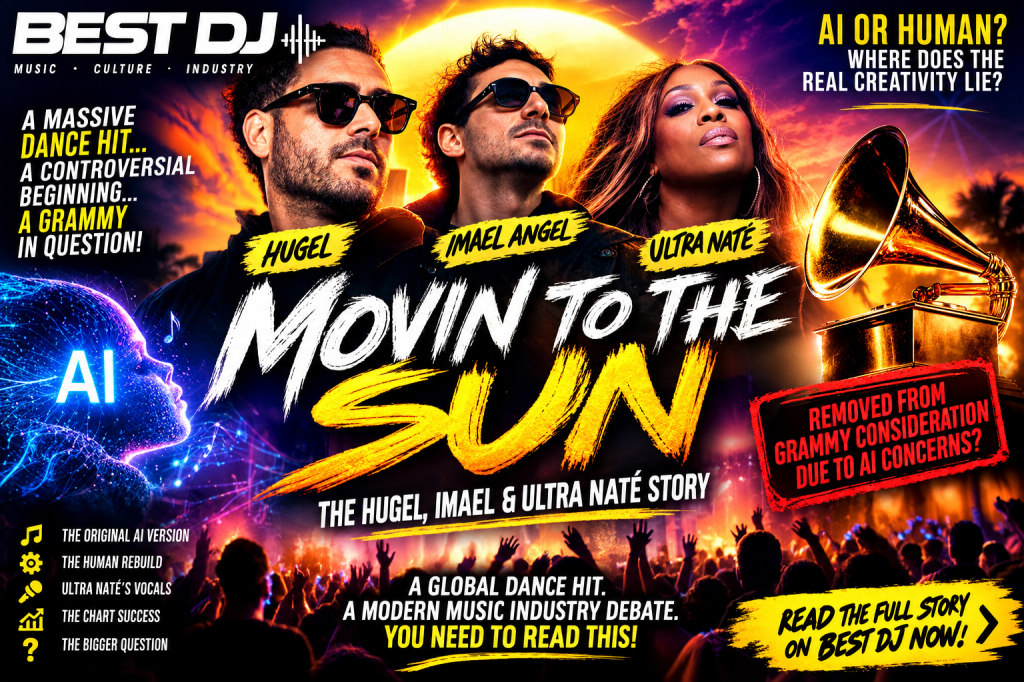
A viral house hit, an AI-generated starting point, a human rebuild — and now a Grammy controversy.
There are plenty of arguments about AI in music right now.
But every so often, a story comes along that forces the industry to stop arguing in generalities and look at one very specific song.
“Movin’ To The Sun” by HUGEL, Imael Angel and Ultra Naté might be that song.
And the story behind it is seriously fascinating.
Because this isn’t simply a case of an AI being asked to make a finished record and a human putting their name on it.
It is a story about an idea travelling through different creative hands — from an AI-assisted original, to a major dance production, to a human vocal performance, to international chart success… and now into a dispute over whether the finished recording should even be considered for a Grammy.
And that raises a huge question:
At what point does an AI-assisted idea become a human-created record?
FIRST, LET’S GET THE GRAMMY STORY STRAIGHT
Reports in September 2026 say that “Movin’ To The Sun” was removed from Grammy consideration following concerns about AI involvement.
That’s slightly different from saying that the song was “denied a Grammy”.
There hasn’t been a Grammy award decision here.
The track was reportedly removed from consideration, and HUGEL has asked the Recording Academy to review the decision and explain which elements of the recording caused the problem. (EDM.com)
And that’s where things get very interesting.
Because the Recording Academy’s own rules don’t simply say:
“Use AI = no Grammy.”
In fact, the Academy’s current guidance says that works containing AI-generated material can still be eligible, provided there is meaningful human authorship or performance in the appropriate category.
Recording Academy CEO Harvey Mason jr. reiterated this in June 2026, explaining that only human creators can receive Grammys, but works containing AI-generated material may still qualify when the human contribution meets the requirements of the category. (Grammy)
So the real question isn’t simply:
“Was AI used?”
It’s:
“How much of the creative work was human?”
And that is a much harder question.
THE STORY STARTED BEFORE HUGEL
The story reportedly goes back to Imael Angel, whose earlier track was titled:
“I’m Moving To The Sun”
According to reporting around the controversy, Angel wrote lyrics and parts of the melody before using AI — including Suno — to help generate an early version.
That version circulated online and eventually became the seed for what would become the HUGEL record. (We Rave You)
And this is where the story gets fascinating.
Because HUGEL didn’t simply upload the AI version and put a new name on it.
He says the record was substantially rebuilt.
FROM AI SEED TO HOUSE HIT
HUGEL has now opened up the production process in a detailed breakdown.
According to his explanation, the finished production involved rebuilding and programming significant parts of the track, including drums, bass, piano, strings, effects and arrangement.
He worked with Maximilian Riehl and Loris Cimino, building the production in Ableton Live.
And then there was one particularly important human element:
Ultra Naté.
The legendary vocalist recorded new vocals specifically for the finished record.
HUGEL has acknowledged that an element of the earlier AI-generated vocal remained in the final production, but says it was used as a layer underneath the new human vocal performance.
His explanation is essentially:
AI helped provide part of the starting material — but the released record was built through extensive human production and performance. (We Rave You)
That distinction is at the centre of the entire controversy.
AND THE RECORD WASN’T EXACTLY A FAILURE…
Quite the opposite.
“Movin’ To The Sun” became one of the biggest dance records of 2026.
The song reached No. 2 on the UK Official Singles Chart, while spending weeks inside the Top 10. It also reached No. 1 on the UK Dance Singles Chart. (Official Charts)
It also topped the US dance radio chart, according to chart reporting, and became a major viral dance record. (Headline Planet)
So this isn’t some obscure experimental AI track sitting in an internet corner.
It became a genuine commercial dance hit.
Which makes the Grammy question considerably more important.
SO… IS IT AN AI SONG?
This is where we should probably slow down.
Because “AI song” can mean several completely different things.
Imagine four scenarios:
1. Someone types a sentence into an AI music generator and releases whatever comes out.
2. A human writes lyrics and melodies, then uses AI to create a demo.
3. A producer takes an AI-generated idea and completely rebuilds the arrangement, instrumentation and production.
4. AI is used for one isolated element inside an otherwise human production.
Those are not creatively identical processes.
And “Movin’ To The Sun” appears to sit somewhere between the second, third and fourth scenarios depending on which stage of the song’s history we’re talking about.
That is precisely why the debate is so difficult.
THE REALLY BIG QUESTION
Here’s the uncomfortable question for the music industry:
If a human creates an idea, AI helps turn that idea into a demo, and another human producer completely rebuilds the record…
Who created the song?
Is the AI merely another production tool?
Is the original melody still fundamentally human?
Does using an AI-generated vocal sample make the finished recording an AI performance?
Does rebuilding 95% of a recording change its creative identity?
And does it matter if listeners can’t hear the difference?
These aren’t theoretical questions anymore.
They’re becoming everyday music-business questions.
THE GRAMMYS HAVE ALREADY DRAWN A LINE — BUT THIS CASE TESTS IT
The Recording Academy has been very clear about one principle:
AI itself cannot receive a Grammy.
But the Academy has also made clear that AI-assisted works are not automatically excluded.
Its current guidance says that AI-generated material can be part of an eligible work where the required human authorship or performance exists. (Grammy)
That creates a fascinating grey area.
Because what happens when the original creative seed contains AI-generated material, but the final record contains substantial human production?
Where exactly is the line?
And perhaps more importantly:
Who gets to decide where that line is?
THIS COULD BECOME A MUCH BIGGER STORY THAN HUGEL
Whatever happens with HUGEL’s appeal, the implications go beyond one dance record.
Electronic music has always been built around technology.
Samplers.
Drum machines.
Synthesizers.
Sequencers.
DAWs.
Auto-Tune.
Software instruments.
Sample libraries.
MIDI.
Each technology has changed what musicians can do.
AI is simply the latest — and arguably the most controversial — addition to that toolbox.
The difference is that previous technologies generally didn’t attempt to generate the creative material itself.
AI can.
And that’s what makes this different.
THE IRONY OF “MOVIN’ TO THE SUN”
There is something almost perfect about the title.
Movin’ To The Sun.
A record born partly from a machine-assisted process, rebuilt by human producers, transformed by a real vocalist, embraced by millions of listeners…
…and now sitting directly in the middle of the biggest argument music has had about technology in decades.
Maybe that’s why this particular record has become such an interesting case study.
It’s not really a story about AI versus humans.
It’s a story about what happens when the two become intertwined.
AND THAT’S THE PART THE MUSIC INDUSTRY NEEDS TO TALK ABOUT
It is easy to shout:
“AI MUSIC IS FAKE!”
It is equally easy to shout:
“AI IS JUST ANOTHER TOOL!”
Neither statement really answers the complicated cases.
The interesting questions are much more specific.
Who wrote the melody?
Who wrote the lyrics?
Who created the original recording?
Which elements were AI-generated?
Which elements were subsequently recreated by humans?
Who performed the final vocal?
Who arranged the record?
Who produced it?
What exactly was submitted to the Grammys?
And perhaps the biggest question of all:
Does the creative process matter more than the finished sound?
THE NEXT CHAPTER
As of now, HUGEL is challenging the reported Grammy decision and asking the Recording Academy to reconsider the track with the production process taken into account. (EDM.com)
We don’t yet know how that review will end.
But we do know something important.
The old argument about whether AI is “coming” for music is already outdated.
It’s here.
It’s already involved in songwriting, demos, sound design, vocals, production and experimentation.
And now it is sitting inside commercially successful records.
The music industry therefore has a choice.
It can try to pretend the technology doesn’t exist.
Or it can start developing much clearer language around human creativity, AI assistance, ownership, credit and transparency.
Because the next “Movin’ To The Sun” is almost certainly already being made somewhere.
And the industry needs to know what it wants to call it.
BEST DJ VIEW
At Best DJ, we think the most interesting part of this story isn’t whether you personally like AI or hate it.
It’s that technology has once again changed the way music is made.
The important thing is understanding what actually happened.
“Movin’ To The Sun” appears to be neither a simple story of “AI made a hit” nor a simple story of “AI had nothing to do with it.”
It’s something much more modern:
an idea moved through AI, producers, technology and human performance until it became a global dance record.
And now the Grammys have been forced to confront exactly where the boundary between those things should be.
The sun is moving.
And so is music.